
Quick Call
+91 9896055098
Our mission is to ensure the generation of accurate and precise findings.
Contact Us 2557/10,2nd Floor,Bangali Mohalla, Ambala Cantt 133001, Haryana (India) +91 9896055098 microdirector@gmail.com
Walk into a chemistry, biology, pharmaceutical, educational, or research laboratory and you will probably notice something interesting: despite all the modern technology, some of the tools used most often are still simple glass vessels.
A beaker. A conical flask. A pipette. A burette. A test tube.
They may look ordinary, but each one has been designed for a different laboratory task. The real challenge is not recognizing the glassware. It is knowing which glassware should be used, why it should be used, and when one piece should not be substituted for another.
That is what makes understanding common laboratory glassware so important.
Laboratory glassware is used for operations such as holding, mixing, transferring, measuring, heating, filtering, reacting, and preparing solutions. Educational laboratory references identify beakers, flasks, test tubes, graduated cylinders, volumetric instruments, and other specialized vessels as core laboratory tools, while ISO maintains separate standards for several categories of volumetric and laboratory glassware.
This guide explains 10 widely encountered laboratory glassware types, their practical uses, their important differences, and how laboratories can make smarter purchasing decisions in 2026.
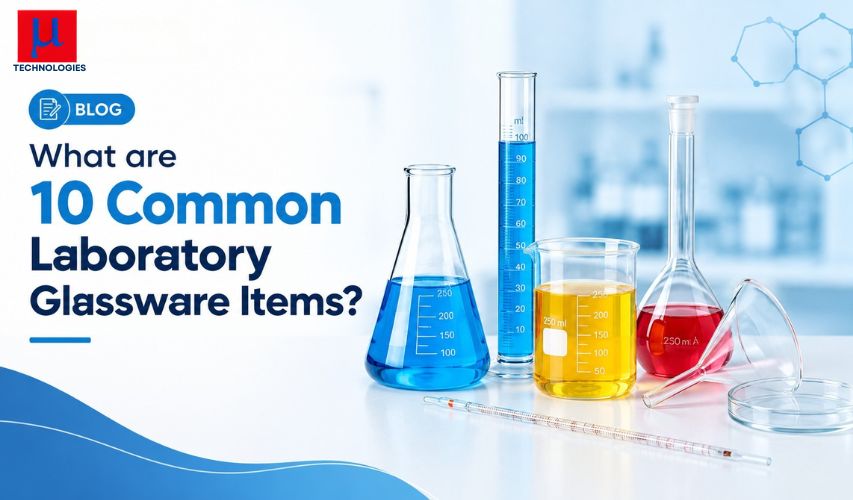
Common laboratory glassware means the glass vessels and apparatus regularly used to perform routine laboratory procedures.
The word “common” does not mean that every laboratory uses exactly the same ten items. A school chemistry laboratory, pharmaceutical quality-control laboratory, microbiology laboratory, and synthetic chemistry laboratory can have different requirements.
However, several glassware categories repeatedly appear across laboratory education and scientific workflows. These include beakers, Erlenmeyer flasks, volumetric flasks, graduated cylinders, pipettes, burettes, test tubes, round-bottom flasks, funnels, and other specialized vessels.
The shape is not simply a matter of appearance.
A narrow neck can make swirling easier without splashing. A long graduated cylinder provides a different measurement format from a broad beaker. A one-mark volumetric flask is designed around a defined volume, while a round-bottom flask is suited to particular heating and reaction setups.
In other words:
The shape often tells you what the glassware is designed to do.
Because laboratory glassware is specialized.
A graduated beaker may show a volume, but that does not turn it into a precision volumetric instrument. ISO 4787 specifically covers the testing, calibration, and use of volumetric instruments to obtain the best accuracy in use.
That distinction becomes especially important when preparing standards, carrying out quantitative analysis, or transferring a defined quantity of liquid.
The beaker is probably the first piece of laboratory glassware most students learn to recognize.
Its straightforward design makes it useful for routine laboratory work such as holding liquids, mixing solutions, transferring materials, and carrying out appropriate heating operations. JoVE describes the beaker as one of the most common pieces of laboratory glassware and notes that its graduations are approximate rather than intended for exact volume measurement.
A beaker can be used for:
mixing liquids or solutions;
holding samples during preparation;
transferring liquids;
routine heating where the specific glassware is suitable;
approximate volume estimation.
ISO 3819 specifies requirements for an internationally acceptable series of laboratory beakers, confirming that the beaker is a standardized laboratory vessel rather than simply a household-style container.
This is where many beginners make a mistake.
A marked beaker is not automatically precision volumetric glassware.
When the procedure requires more accurate volume control, laboratories use instruments such as volumetric flasks, volumetric pipettes, burettes, or suitable measuring cylinders. ISO 4787 provides methods for testing, calibration, and use of such volumetric instruments.
Best suited for: general laboratory preparation, mixing, holding, and routine handling.
The Erlenmeyer flask, also called a conical flask, has a broad lower body, sloping sides, and a narrower neck.
That geometry gives it a practical advantage: liquids can be swirled inside the flask with less risk of splashing over the sides than in a wide-open vessel. JoVE describes flasks as being designed so contents can be swirled without spilling and identifies the Erlenmeyer flask as one of the most common laboratory flasks.
It is commonly used for:
mixing solutions;
swirling liquids;
sample preparation;
reaction work;
some heating and reflux-related procedures where the product is intended for that application.
The narrow neck can also make the flask easier to stopper or cover compared with an open beaker.
Think of it this way:
A beaker is convenient for access and pouring.
An Erlenmeyer flask is especially convenient when mixing by swirling matters.
The right choice depends on what you need the container to do, not simply what happens to be available on the laboratory shelf.
Best suited for: mixing, swirling, sample preparation, and suitable reaction procedures.
If laboratory glassware had a “precision specialist,” the volumetric flask would be one of the clearest examples.
A one-mark volumetric flask is designed for preparing a solution to a specified volume. ISO 1042 addresses one-mark volumetric flasks, and ISO 4787 includes volumetric flasks within its framework for testing, calibration, and use of volumetric instruments.
Volumetric flasks are used when a laboratory needs to prepare a solution to a defined volume, particularly in quantitative and analytical procedures.
The long, narrow neck and calibration mark are important because the final liquid level is intended to be brought to a specific reference point.
Read more: Volumetric Flask Uses
The instrument is designed around a defined volume rather than providing a whole series of approximate graduations.
This is one reason it should not be casually replaced with a beaker simply because both containers can “hold liquid.”
ISO's current revision work is also notable. In 2026, ISO lists ISO/DIS 1042, Edition 5 as a draft international standard under development to replace ISO 1042:1998. The draft adds several capacities and updates dimensional and design provisions.
That is an interesting reminder that even familiar laboratory glassware continues to evolve through standardization.
Best suited for: defined-volume solution preparation and precision-oriented volumetric work.
A graduated cylinder is designed around a scale rather than the single calibration mark used on a one-mark volumetric flask.
ISO 4788 specifies dimensional, material, constructional, and metrological requirements for graduated measuring cylinders suitable for general laboratory use.
A graduated cylinder is useful when a laboratory needs to measure a liquid volume using a graduated scale rather than prepare a solution to one fixed calibration point.
It is especially practical for routine liquid handling where the laboratory needs a measurable range of volumes.
Both can have markings, but they are not interchangeable.
A beaker is primarily a general-purpose vessel.
A graduated cylinder is specifically constructed for volume measurement.
The simplest distinction is:
Graduated cylinder: measure different volumes using a scale.
Volumetric flask: prepare a specified volume using a defined calibration mark.
For higher-accuracy volumetric work, laboratories should select the instrument appropriate to the required measurement and applicable standard. ISO 4787 specifically addresses calibration and use of volumetric instruments.
Best suited for: routine volume measurement.
A burette looks deceptively simple: a long graduated glass tube with a valve or stopcock.
Its purpose, however, is quite specific.
A burette is designed to deliver controlled and measurable quantities of liquid. ISO 385 establishes metrological and construction requirements for an internationally acceptable series of laboratory burettes.
The most familiar application is titration, where the operator needs controlled addition of one solution to another.
JoVE identifies burettes as analytical glassware used to dispense variable but precise volumes, commonly in titration experiments.
This is a useful distinction:
A pipette is commonly used to transfer a specified amount of liquid.
A burette is designed to deliver a variable amount while allowing the delivered volume to be determined from the instrument's scale.
That difference is fundamental to many analytical workflows.
ISO 385 remains current as of 2026; ISO states that the 2005 edition was last reviewed and confirmed in 2019.
Best suited for: titration and controlled volumetric delivery.
Pipettes are another major category of laboratory glassware, but “pipette” is not a single design.
Different types serve different measurement purposes.
ISO 648 specifies metrological and constructional requirements for single-volume pipettes, including one-mark and two-mark volumetric pipettes for general laboratory purposes. ISO 835 separately addresses graduated pipettes.
Pipettes are commonly used to:
transfer liquid;
measure defined quantities;
prepare solutions;
support analytical procedures.
Open University laboratory teaching material identifies pipettes, burettes, and volumetric flasks as volumetric glassware used where more accurate volume is required.
A volumetric pipette is designed around a defined volume.
A graduated pipette uses a scale to support measurement across a range.
ISO maintains separate standards for these categories, which is another reason the word “pipette” alone is not enough when specifying laboratory equipment.
Best suited for: controlled liquid transfer and volumetric measurement according to the specific pipette design.
The test tube is one of the simplest pieces of laboratory glassware, but its simplicity is exactly why it remains useful.
JoVE describes test tubes as relatively small cylindrical vessels used to store, heat, and mix chemicals, particularly in qualitative observational procedures.
Test tubes are useful for:
holding small samples;
carrying out small-scale reactions;
mixing small quantities;
heating appropriate samples;
qualitative observation.
Their small size makes them practical for demonstrations and experiments where only a limited quantity of material is required.
A student can observe a colour change or other visible reaction in a small vessel without requiring a large volume of chemicals.
That makes the test tube particularly useful in educational chemistry and biology environments.
Best suited for: small-scale reactions, sample handling, and qualitative laboratory work.
A round-bottom flask may look less convenient than a flat-bottom beaker or flask, but its shape serves a purpose.
JoVE describes round-bottom, or boiling, flasks as common in synthesis experiments because their rounded shape supports even heating and stirring. The same source notes that their necks commonly use ground-glass joints for connection to condensers and other glassware.
Typical applications include:
synthesis;
heating;
reflux;
distillation;
connected glassware assemblies.
DWK also describes jointed laboratory glassware as important in processes such as distillation, extraction, filtration, reflux, and other connected laboratory workflows.
The spherical shape is useful in applications involving heating and mixing, but the flask normally requires appropriate support because it does not stand independently like a flat-bottom vessel.
This is a good example of a broader laboratory principle:
The more specialized the job, the more specialized the glassware design tends to become.
Best suited for: synthesis, heating, distillation, and reflux assemblies.
A funnel may appear almost too simple to deserve a place in a laboratory glassware list.
But laboratory funnels perform important transfer and filtration functions.
JoVE includes funnels among common laboratory apparatus and distinguishes funnel applications from other glassware functions.
Depending on the specific design, laboratory funnels can support:
controlled transfer of liquids;
transfer of solids;
filtration;
connection to laboratory filtration setups.
Not every funnel is made for the same process.
A simple transfer funnel and a specialized filtration funnel can have very different purposes.
So when purchasing laboratory glassware, the word “funnel” alone is not enough. The laboratory should consider the required diameter, stem, filtration method, compatible filter media, and connection requirements.
Best suited for: transfer and application-specific filtration.
The Petri dish is particularly familiar in biology and microbiology environments.
Its shallow, broad design creates a useful surface for laboratory procedures involving observation and biological samples. Common laboratory references include Petri dishes among routine laboratory glassware categories, although modern laboratories may also use plastic alternatives depending on the application.
Depending on the laboratory procedure, Petri dishes can be used for:
biological culture work;
sample observation;
temporary holding of small specimens or materials;
educational demonstrations.
The answer is surface area and accessibility.
A Petri dish is shallow and wide, making it easier to observe material spread over a broad surface.
A beaker is deeper and more useful as a general-purpose liquid vessel.
The two may both “hold something,” but the intended laboratory workflow is completely different.
Best suited for: biology, microbiology, observation, and suitable culture applications.
A practical way to choose common laboratory glassware is to begin with the job that needs to be done.
For routine mixing and holding, beakers and Erlenmeyer flasks are common choices. Their designs differ because the two vessels support different handling styles.
For procedures where volume accuracy matters, laboratories use dedicated volumetric instruments such as volumetric flasks, volumetric pipettes, burettes, and appropriate measuring cylinders. ISO 4787 specifically provides methods for testing, calibration, and use of volumetric instruments.
Test tubes are practical when only small quantities are required.
Suitable Erlenmeyer and round-bottom flasks can be used in heating and reaction setups when their specific design and manufacturer instructions support the application.
Funnels are useful when a process requires controlled transfer or filtration.
One reason laboratory glassware is so closely associated with borosilicate glass is its combination of useful thermal and chemical properties.
ISO 3585 defines properties for borosilicate glass 3.3, and ISO confirmed the standard again in 2026, meaning the current standard remains in force.
Corning describes its PYREX laboratory glass as low-expansion borosilicate glass and highlights properties including chemical resistance and resistance to thermal shock.
Because material is only one part of the specification.
Glass type, product design, thickness, intended use, heating conditions, and manufacturer instructions can all affect suitability.
Corning, for example, distinguishes between laboratory glassware intended for heating and storage containers that should not be directly heated.
So the smarter purchasing question is not:
“Is this glass?”
It is:
“Is this glassware designed and specified for the procedure I need to perform?”
One of the easiest laboratory mistakes is choosing glassware because it looks like the right size.
A 500 mL beaker and a 500 mL volumetric flask may both carry a “500 mL” designation, but that does not mean they serve the same measurement purpose.
ISO 4787 applies to volumetric instruments from 100 µL to 10,000 mL and includes single-volume pipettes, graduated pipettes, burettes, volumetric flasks, and graduated measuring cylinders.
Open University's laboratory teaching material also explains that volumetric glassware is used where more accurate volume is required and emphasizes correct meniscus reading.
General work: choose general-purpose glassware.
Measured work: choose suitable graduated glassware.
Precision work: choose appropriate volumetric glassware and consider calibration and applicable standards.
That simple framework can make procurement and day-to-day laboratory work much more sensible.
Once a laboratory knows what it needs, the next question is:
Where should the glassware come from?
Choosing a lab glassware manufacturer should involve more than comparing two product photographs and selecting the lower price.
Confirm the glass type and whether it is appropriate for the intended laboratory conditions.
Check capacity, shape, neck dimensions, graduation, connections, and other specifications relevant to the application.
For volumetric equipment, measurement requirements matter. ISO 4787 is specifically concerned with testing, calibration, and use of volumetric instruments to obtain the best accuracy in use.
Depending on the product, relevant ISO standards can include ISO 3819 for beakers, ISO 385 for burettes, ISO 648 for single-volume pipettes, ISO 835 for graduated pipettes, ISO 4788 for graduated measuring cylinders, and ISO 1042 for one-mark volumetric flasks.
For institutions and commercial laboratories, having access to multiple laboratory glassware categories can simplify procurement.
For professional laboratories, specifications and product information can be as important as the physical product because the purchasing team needs to match equipment to its procedure and quality requirements.
The biggest mistake is often not choosing a “bad” product.
It is choosing a good product for the wrong job.
Beakers are general-purpose vessels. Dedicated volumetric instruments exist for higher-accuracy volume work.
Capacity is important, but so are design, material, graduation, tolerance, connections and intended application.
Borosilicate glass has useful thermal properties, but laboratory products still have specified operating conditions. Corning explicitly distinguishes heating-compatible laboratory products from containers that should not be directly heated.
When volume accuracy matters, calibration and appropriate use become part of the measurement process rather than an optional extra.
|
Laboratory Glassware |
Main Laboratory Glassware Uses |
Measurement Role |
|
Beaker |
Mixing, holding, transfer, routine heating |
Approximate/routine |
|
Erlenmeyer Flask |
Mixing, swirling, preparation, suitable reactions |
Not primarily volumetric |
|
Volumetric Flask |
Preparing a defined volume |
Precision-oriented |
|
Graduated Cylinder |
Measuring liquid volumes |
Graduated measurement |
|
Burette |
Controlled liquid delivery, titration |
Volumetric |
|
Pipette |
Controlled liquid transfer |
Depends on type |
|
Test Tube |
Small-scale reactions and samples |
Not primarily volumetric |
|
Round-Bottom Flask |
Heating, synthesis, reflux, distillation |
Process-specific |
|
Laboratory Funnel |
Transfer and filtration |
Process-specific |
|
Petri Dish |
Observation and suitable biological culture work |
Not primarily volumetric |
The functional distinctions are consistent with educational laboratory references and the relevant ISO standards for volumetric instruments and specified glassware categories.
Here is where the laboratory glassware story becomes more interesting.
It is tempting to assume that automation, digital instruments and disposable laboratory plastics will make traditional glassware less important. The available market evidence does not support such a simple conclusion.
Grand View Research estimates the global laboratory glassware market at approximately USD 2.0 billion in 2026, with a forecast of approximately USD 2.45 billion by 2030, representing a projected 3.3% CAGR from 2024 to 2030. The company identifies pharmaceutical, biotechnology, and diagnostics R&D as important demand drivers.
Grand View Research estimates India's laboratory glassware market generated approximately USD 25.1 million in 2024 and projects it to reach approximately USD 28.6 million by 2030, corresponding to a 2.2% CAGR from 2025 to 2030. The report identifies pipettes as the largest revenue-generating type segment in India in 2024 and also the fastest-growing type segment in its forecast.
These are market-research estimates rather than guarantees of future sales, and different research companies can produce different market totals because they use different definitions and methodologies.
The most important future opportunity may not simply be more glassware.
It may be better-specified glassware.
As laboratories become more measurement-focused, the relevance of calibration, standards, material selection, dimensions and application-specific equipment can increase. ISO 4787's focus on testing, calibration and use demonstrates how closely volumetric glassware is connected with measurement quality.
There is already evidence that they are.
In 2026, ISO has a new draft edition of ISO 1042 under development for one-mark volumetric flasks. The draft introduces additional capacities and updates several design provisions.
ISO 3585 for borosilicate glass 3.3 was also reviewed and confirmed in 2026.
This suggests that laboratory glassware is not a frozen product category. Standards, measurement practices, product design and laboratory workflows continue to evolve.
The more realistic future is not necessarily glass versus automation.
It is more likely to be:
glassware + automation + better measurement + specialized workflows.
Some laboratories will continue to use traditional vessels for routine work, while others will use specialized glass assemblies alongside automated systems and digital laboratory technologies.
The important change may be that laboratories increasingly ask:
“What specification do we need?”
instead of simply:
“Which glassware should we buy?”
That is a much more professional way to approach laboratory procurement.
The laboratory may become more digital, but liquids still need to be held, transferred, mixed, measured, heated, separated, observed, or prepared.
That is why laboratory glassware remains relevant.
The beaker solves a different problem from the volumetric flask.
The pipette solves a different problem from the burette.
The test tube solves a different problem from the round-bottom flask.
And the funnel is designed for a different task again.
The value of laboratory glassware is therefore not in the glass alone.
Its value is in the combination of material, geometry, calibration, capacity and intended application.
Ten widely encountered items include the beaker, Erlenmeyer flask, volumetric flask, graduated cylinder, burette, pipette, test tube, round-bottom flask, laboratory funnel, and Petri dish. The exact combination can vary according to the type of laboratory.
Common laboratory glassware uses include holding, mixing, measuring, transferring, heating, filtering, preparing solutions, carrying out reactions, and supporting analytical or biological procedures.
Volumetric flasks, volumetric pipettes, burettes, and appropriate graduated measuring instruments are used for volumetric work, depending on the specific procedure and required accuracy. ISO 4787 provides methods for testing, calibration, and use of volumetric instruments.
A beaker's graduations are generally approximate. When greater accuracy is required, appropriate volumetric equipment should be selected instead.
A beaker is primarily a general-purpose vessel for holding, mixing, and routine laboratory work, while a one-mark volumetric flask is designed for preparing a defined volume.
A burette is used to deliver measured quantities of liquid in a controlled manner and is particularly associated with analytical procedures such as titration. ISO 385 specifies metrological and construction requirements for laboratory burettes.
Borosilicate glass has useful thermal and chemical properties. ISO 3585 specifies properties for borosilicate glass 3.3, while Corning describes low expansion, chemical resistance and thermal-shock resistance among the characteristics of its laboratory borosilicate products.
No. Glassware requirements depend on the laboratory's activities. Chemistry, biology, pharmaceutical, educational, testing and research laboratories can require different combinations of general-purpose, volumetric and specialized glassware.
Start with the application and then compare material specification, capacity, design, measurement requirements, relevant standards, calibration information, product range, documentation, and supplier support.
Current market estimates project continued global laboratory glassware growth through 2030, while ongoing ISO standards work shows continued attention to laboratory glassware design and measurement requirements.
The next time you see ten pieces of glassware sitting on a laboratory bench, look at them differently.
They are not ten versions of the same container.
Each one was developed around a different laboratory problem.
A beaker gives you flexibility.
An Erlenmeyer flask makes mixing easier.
A volumetric flask is built around a defined volume.
A graduated cylinder gives you a graduated measurement format.
A burette provides controlled delivery.
A pipette supports controlled liquid transfer.
A test tube makes small-scale work practical.
A round-bottom flask becomes part of heating, reflux, and distillation systems.
A funnel supports transfer and filtration.
A Petri dish provides a shallow format useful in biological and observational applications.
That is why choosing laboratory glassware should never be reduced to size and price.
The better approach is:
Application → Material → Design → Capacity → Accuracy → Standards → Quality → Supplier
For laboratories, educational institutions, research facilities, pharmaceutical and testing environments looking for dependable laboratory equipment and glassware solutions, Micro Technologies can be part of the sourcing conversation.
Whether the requirement is common laboratory glassware for routine work or more specialized laboratory glassware for measurement and process applications, selecting the right product starts with understanding the job it needs to perform.
Choose the glassware for the application—not simply for the appearance.
Explore related educational resources from Micro Technologies for deeper guidance on laboratory glassware, volumetric flasks, and laboratory equipment selection.
